

Please read the back pain section of this website before carrying out the following.
- Back pain is often caused by weakness in the muscles that stabilise your lower back and pelvis. Therefore the first exercise to start with is Number 7 and when this becomes easy progress to Number 8, 9, 10 and 11.
- Along side this one you add Number 1 and when this becomes easy Number 2, 3 and 4. It may takes days or weeks to progress from each exercise to the next.
- Another exercise that you can start with is Number 5 which explains standing and stepping posture.
- Only when you have completely mastered these exercises should you progress to planking as shown in Number 16.
- Also number 43 through to 46 to work the back muscles in sitting. Number 47 is good if you need to lean forward when sitting, for example if you are a cyclist.
- Upper back stiffness is another cause of back pain so incorporate number 48, 49 or 67 into your daily routine.
- Number 59 can help to loosen up the lower back, particularly first thing in the morning before you get out of bed.
- Breathing techniques are brilliant at releasing tension in the back so practice number 78. 79 or 80.
- Number 6 shows you how to bend or lean forward correctly from the hips which is important for lots of activities like walking up hill, going up stairs, standing up from sitting, bending down to pick things up and lifting and carrying.
- The correct lifting and carrying technique will enable your back to heal and reduce recurrence and number 19 explains how to do this.
- Leg strengthening and general body strengthening will help you to maintain your improvements so learn to squat properly in number 20 and 22 and, when you have no pain, you can progress to split squats or lunges as shown in number 23 and 24.
- Tight glute muscles can affect your hip and back pain so use number 53 for Foam Roller release.
Contact us for more details. Our team is ready to help.
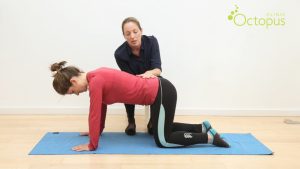
01 – Superman: Positioning
This is part 1 of the ‘Superman’ exercise series.The Superman exercise is great for core and back strength. Use this...
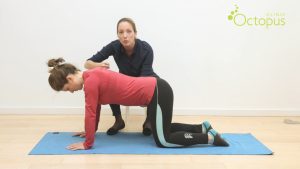
02 – Superman: Contract Deep Abs
This is the second video of the ‘Superman’ exercise series. The Superman exercise is great for core and back strength...
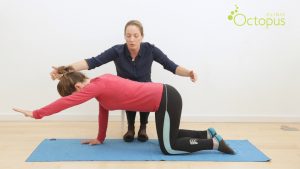
03 – Superman: Arms
This is the third video of the ‘Superman’ exercise series where we start adding some arm movement. The Superman exercise...
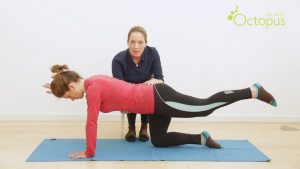
04 – Superman: Arms And Legs
This is the 4th and final video of the ‘Superman’ series. Here we add leg movements into the exercise. The...
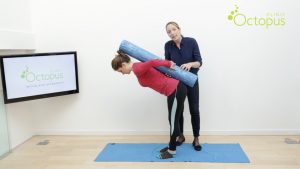
06 – Standing Hip Bend: ‘Waiters Bow’
This is an important exercise showing you how to bend properly from the hips while maintaining your pelvis and spine in...
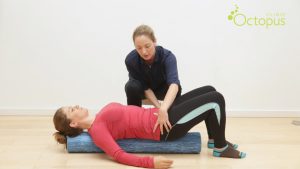
07 – Foam Roller On Floor: Positioning Pelvic Neutral
Back pain is often caused by weakness in the muscles that stabilise your lower back and pelvis. Stability in these muscles...
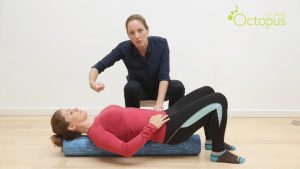
08 – Foam Roller On Floor: Contract Pelvic Floor and Deep Abs
This is the second video in our foam roller series for back and hips. The stability of your low back and...
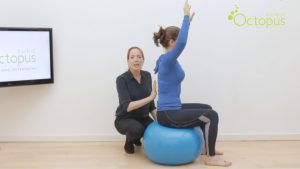
44 – Sitting: Gym Ball Stability
This is the 2nd video in our sitting series. Correct sitting posture and stability is very important to avoid muscle...
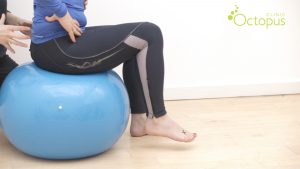
45 – Sitting: Gym Ball Stability Leg Lifts
Carrying on with the sitting series, this exercise adds some leg lifts to your sitting stability work. Only attempt this...
46 – Sitting: Gym Ball Pelvic Tilts
This is the 4th stage in the Sitting series designed to train your stability muscles either sitting on a ball...
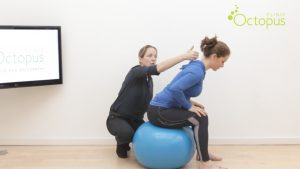
47 – Sitting: Gym Ball Hip Flexion
This is the last stage of our Sitting series to improve your posture, strength and stability while seated to prevent...
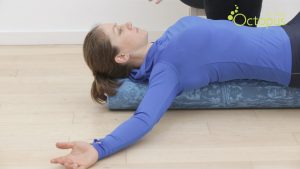
48 – Upper Back: Release On Foam Roller
This exercise shows you how to release your upper back on the foam roller. This can be very helpful for...
Please read the knee pages in this website before watching the following exercises.
- Knee pain is often caused or contributed to by the alignment of the whole of the lower limb. Exercise Number 20 is therefore the best starting point followed by Number 22.
- After a few weeks when these become easy you can start to introduce Number 21, 23 and 24. However, if you can't do a single knee bend with perfect alignment as described in Number 21 you need to do Numbers 37, 38 and 39 first.
- Numbers 37, 38 and 39 are important in their own right, especially if you have any problems with your knee cap, ITB or patella tendon so do make sure you master these.
- Understanding and practicing the correct foot movement through gait (walking) can also help knee pain so watch Number 29 to learn how.
- If you are a runner or simply if walking is painful Number 25 is brilliant at enabling your body to incorporate the muscles and movements you have trained so far into your walking and running technique.
- If you are returning to running and your physio has said it is time to introduce impact start with Number 26 and 27 and then progress to Number 28. It may take a number of weeks to build up through these levels.
- If walking downstairs is painful and you have mastered lower leg alignment then it is time to practice Number 30 and 31.
- To train correct alignment and strength for walking upstairs practice Number 32 and, when you are ready, Number 32.2. Once you have mastered these, for more advanced exercises, practice Number 33 and 34.
- Number 36 strengthens and lengthens the calf muscles which can help to reduce knee pain.
- Balance and proprioception are key to recovery and injury prevention so make sure you incorporate Numbers 70, 71 and 72 to your routine.
- If you have tight Quads, releasing them with a foam roller may help, see number 51.
For videos of knee stretches please go to our Dynamic Stretching and Static Stretching series which include stretches of the quadriceps (front of knee) hamstrings (back of knee) calf muscles (both gastrocnemius and soleus) and the hip musculature.
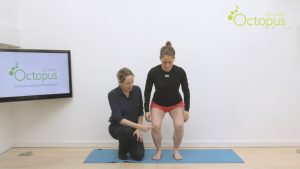
20 – Lower Limb Alignment: Mini Squat
Knee pain is often caused or contributed to by the alignment of the whole of the lower limb. Leg and...
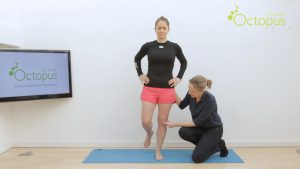
21 – Lower Limb Alignment: One Leg Knee Bend
Once you’ve spent a few weeks working on your squat technique with these exercises: 20 – Lower Limb Alignment: Mini...
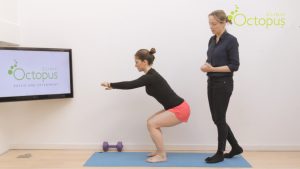
22 – Lower Limb Alignment: Squatting
Knee pain is often caused or contributed to by the alignment of the whole of the lower limb. Squats are...
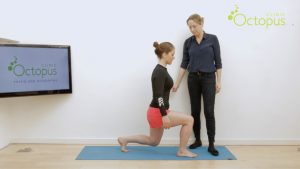
23 – Lower Limb Alignment: Split Squat and Lunge
This exercise is great for continuing to build on your lower limb strength. Ensure you’ve mastered your squat technique using...
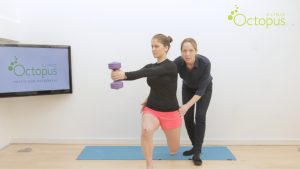
24 – Lower Limb Alignment: Advanced Split Squat and Lunge
Take your squat game up a notch with this video. It is important you know the alignment needed – check...
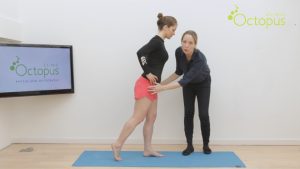
25 – Lower Limb Alignment: Running Man
Continuing on with our lower limb alignment series for knee pain, this is the Running Man. If you are a...
Please read the shoulder pages of this website before watching the videos.
- Correct shoulder posture is key to reducing shoulder pain as described in Number 12. Once you have mastered this you can progress to add movement as in Number 13.
- Learning how to move your shoulder blade can be assisted by the exercise in Number 14. This exercise will also strengthen the shoulder blade muscles which are essential in shoulder function and recovery. You can progress to exercise Number 18 and Number 18.2, particularly if you have pain when you move your shoulder out to the side or above your head.
- The rotator cuff muscles hold the ball in the shoulder socket throughout movement. You need to train these muscles to fire correctly in whatever range of movement is painful, although the exercise itself should be completely pain free. Exercise Number 17 shows you how to do this.
- The shoulder blade sits on your rib cage, because of this end of range shoulder movement is reliant on the upper back joints moving. Therefore mobilising your upper back can help shoulder pain as described in Number 48, 49 and 67 - the latter being particularly useful as you can do it at your desk.
- When you know how to stabilise your shoulder blade it is time to work your rotator cuff muscles in standing, as in Number 82. This exercise should be done in whatever range of motion is weak or painful but the exercise itself should be pain free.
- Core muscles have been shown to be key to reducing shoulder pain so carry out exercises Number 7, 8, 9, 10, 11 and Numbers 1, 2, 3, and 4 to achieve this.
- Press ups done correctly can aid the recovery of the shoulder, but done badly can damage it. Watch Number 15 to learn the correct technique.
- The buttock and leg muscles also play a role in shoulder function so Number 22 (squats) Number 23 (split squats) and Number 24 (advanced split squats) are worth incorporating as soon as possible.
- Your neck and shoulder are directly connected with muscles, nerves and connective tissues, therefore correcting neck posture is important with shoulder pain - check out Number 66 to learn about neck posture, and then Number 69 to learn stretches that release the neck.
- To strengthen the neck use exercises Number 68 and then 81.
01 – Superman: Positioning
This is part 1 of the ‘Superman’ exercise series.The Superman exercise is great for core and back strength. Use this...
02 – Superman: Contract Deep Abs
This is the second video of the ‘Superman’ exercise series. The Superman exercise is great for core and back strength...
03 – Superman: Arms
This is the third video of the ‘Superman’ exercise series where we start adding some arm movement. The Superman exercise...
04 – Superman: Arms And Legs
This is the 4th and final video of the ‘Superman’ series. Here we add leg movements into the exercise. The...
07 – Foam Roller On Floor: Positioning Pelvic Neutral
Back pain is often caused by weakness in the muscles that stabilise your lower back and pelvis. Stability in these muscles...
08 – Foam Roller On Floor: Contract Pelvic Floor and Deep Abs
This is the second video in our foam roller series for back and hips. The stability of your low back and...
Please read the Work and Stress sections of this website to learn how to set up your Work Station to reduce and prevent pain as well as tips on stress reduction.
- Get your sitting posture right at work by watching Number 43 and train your stability muscles either sitting on a ball or sitting at your desk using Numbers 45, 46 and 47.
- Number 66 pays closer attention to your neck posture and Numbers 12 and 13 your shoulder posture, both essential when sitting at your desk. Carry out some gentle neck stretching first to loosen your neck as demonstrated in Number 69.
- To strengthen your neck muscles Number 68 can easily be done at work.
- Number 67 - the best exercise you can do at your desk are chair twists that mobilise your spine, release tension and can treat and prevent back pain, neck pain and headaches. When you get home you can release your upper back further by carrying out Number 48 and 49.
- Likewise, another way to reduce the effects of being slumped over your desk, phone, PC etc all day is to lie on a foam roller as shown in Number 7 and then progress this to training your deep abdominal muscles in Numbers 8, 9, 10 and 11 if you wish.
- Standing up at your desk and doing some squatting will help to keep your legs strong and improve circulation as well as reducing the risk of back, knee and foot pain - learn how with Number 22.
- Learning to breath properly is an excellent and versatile way of reducing stress and tension at work. The breathing exercises in Numbers 78, 79 and 80 are performed in lying, but once you have practiced them there is no reason why you cant adapt them to do them sitting at your desk or on your commute.
- If you do any bending, lifting or carrying at work then Number 19 is essential for you, though few people don't do this kind of activity at some point in their day.
07 – Foam Roller On Floor: Positioning Pelvic Neutral
Back pain is often caused by weakness in the muscles that stabilise your lower back and pelvis. Stability in these muscles...
08 – Foam Roller On Floor: Contract Pelvic Floor and Deep Abs
This is the second video in our foam roller series for back and hips. The stability of your low back and...
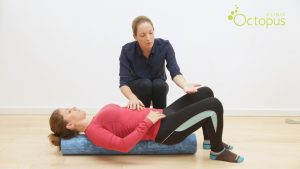
09 – Foam Roller On Floor: Knee Drops
This is the 3rd video in our Foam Roller series. These exercises are a great way of training your deep...
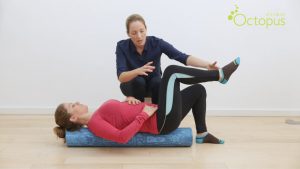
10 – Foam Roller On Floor: Leg Lifts
Now we’re getting more advanced in our Foam Roller series. You should be getting good control of your core and...
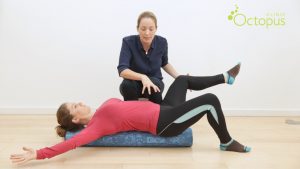
11 – Foam Roller On Floor: Legs And Arms
You’ve made it to the final level of this foam roller series! In this video we’ll add arm movements as...
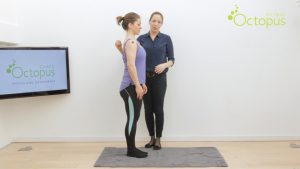
12 – Shoulder: Posture/Position
Correct shoulder posture is key to reducing shoulder pain. Learn how to correct your own shoulder posture and movement in...
About 70% of our patients are runners. The expertise of our specialist running physiotherapists and the huge amount of information on this website on running and marathon training reflects this. Please use our search tool have a good read of it as well as checking out these videos.
- The running man exercise in Number 25 practices many of the components of running alignment together so you can try this out. However, it is advisable to practice components of this alignment first.
- The stability of your low back and pelvis is essential in efficient running technique and Numbers 7, 8, 9, 10 and 11 of our foam roller series along with Numbers 1, 2, 3, and 4 of our superman series work these muscles - you can start the first exercise in both series at the same time.
- To learn the correct running posture first practice correct standing and walking posture as per Number 5 and then flex from the hips slightly. This hip flexion in standing is trained by Number 6.
- To more closely assess and correct your lower limb alignment for running practice Number 20 and 21. Lots of people struggle to achieve the correct alignment in a single knee bend and this is absolutely essential for pain free running. Carry out the wall/ball series - Numbers 37, 38 and 39 and in the meantime continue to carry out squats on both legs as shown in Number 22.
- When you can maintain the correct alignment doing a mini knee bend (Number 21) then check out Number 29 to learn about normal foot pronation and then go back to running man (Number 25) and progress to landing - Number 26, jumping - Number 27 and hopping - Number 28.
- To strengthen your legs further carry out split squats - Numbers 23 and 24, eccentric step downs - Numbers 30 and 31, step ups - Numbers 32 and 32.2 as well as stepping up and over - Number 33.
- If you struggle with foot posture or have foot, ankle or lower leg pain then train your foot and ankle posture using exercises Number 40, 41, and 42.
- Decent calf muscle strength and flexibility is super important in performance and injury prevention and these exercises are the best way to achieve this - Number 35 and 36. Make sure you get your ankle alignment right when you are doing them by checking out Number 42 first.
- Hip flexors lift your thigh upwards and drills involving these muscles can help running technique - Number 77 shows how you can strengthen these muscles.
- To avoid shoulder, neck or arm pain when running make sure you pay attention to your shoulder posture as per exercise Number 12 and 13.
- The upper back can become tight when running putting undue pressure on the low back and neck and reducing arm swing so release this area out with Number 48, 49 or 67.
- Massaging your outer thighs with a foam roller after exercise can help to alleviate knee pain - see Number 50, while Numbers 51, 52 and 53 use the foam roller to release the quads, calves and glutes
- Balance and proprioception have been shown to prevent injuries in athletes and is particularly important if you have had any ligament injuries or you are running on uneven surfaces - practice Numbers 70, 71 and 72.
- Learning how to breathe properly when running will keep your body relaxed and your muscles and brain well oxygenated - practice in lying first - Number 78 - then incorporate into your running technique.
Finally don't forget to static stretch AFTER running while your muscles are still warm: quads - 54, hamstrings - 55, calves - 56, adductors 57, glutes - 58, back - 59, hip flexors - 60.
Do not do static stretches before or during running. A decent warm up is most important but if you are doing a sport involving a larger range of motion than simply long distance road running then dynamic stretching is advisable: quads and hamstrings - 61, hip adductors and abductors - 62, hip and rotation and opening 63, arms - 64, upper back and body rotation 65.
01 – Superman: Positioning
This is part 1 of the ‘Superman’ exercise series.The Superman exercise is great for core and back strength. Use this...
02 – Superman: Contract Deep Abs
This is the second video of the ‘Superman’ exercise series. The Superman exercise is great for core and back strength...
03 – Superman: Arms
This is the third video of the ‘Superman’ exercise series where we start adding some arm movement. The Superman exercise...
04 – Superman: Arms And Legs
This is the 4th and final video of the ‘Superman’ series. Here we add leg movements into the exercise. The...
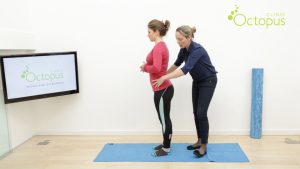
05 – Standing And Walking Posture: Positioning And Stepping
We often have poor posture in standing which can lead to muscle imbalances and pain. This video will help you...
06 – Standing Hip Bend: ‘Waiters Bow’
This is an important exercise showing you how to bend properly from the hips while maintaining your pelvis and spine in...
Please check out the information on cycling training, alignment and injury prevention on this website as well as the videos below. Our cycling specialist physio carries out Cycling Assessments so please do use the website search tool or get in touch to find out more.
- Exercise Number 83 is without doubt your most important starting point: How to get your body into the right position to optimise performance and prevent injury. The exercises following this break down components of this alignment to equip you with the strength and the mobility to get into this position.
- It is always important to build strong foundations, these are the stability muscles of the lower back and pelvis. Once you have got the basics on the foam roller in Number 7 and 8 you can move to the superman series Numbers 1, 2, 3, and 4.
- Once you know how to activate these deep muscles you can practice them in sitting using exercises Numbers 44, 45 and 46.
- A fundamental part of cycling is to able to flex deeply into your hips which will help to avoid back and neck pain. Learn how to do this in standing with Number 6 and in sitting with number 47.
- Another common correction is neck posture so learn in more detail how to correct this using Number 66 and how to strengthen your neck muscles in number 68. If your neck feels tight carry out these neck stretches - Number 69.
- If you have a tendency to let your knee drop in when you cycle and/or have knee cap or tendon pain then foam rolling the outer side of your thigh can help give relief to these symptoms - see Number 50.
- The upper back can become stiff in cyclists causing neck, shoulder arm or low back pain so keep it loose by carrying out Number 48, 49 or 67.
- Numbers 54, 55 and 58 show you how to correctly stretch your quadriceps, hamstrings and buttock/glute muscles respectively, all of which can get tight when cycling. Number 59 demonstrates how you can release your back to prevent or treat pain or stiffness and number 51 can help release tight Quads.
01 – Superman: Positioning
This is part 1 of the ‘Superman’ exercise series.The Superman exercise is great for core and back strength. Use this...
02 – Superman: Contract Deep Abs
This is the second video of the ‘Superman’ exercise series. The Superman exercise is great for core and back strength...
03 – Superman: Arms
This is the third video of the ‘Superman’ exercise series where we start adding some arm movement. The Superman exercise...
04 – Superman: Arms And Legs
This is the 4th and final video of the ‘Superman’ series. Here we add leg movements into the exercise. The...
05 – Standing And Walking Posture: Positioning And Stepping
We often have poor posture in standing which can lead to muscle imbalances and pain. This video will help you...
06 – Standing Hip Bend: ‘Waiters Bow’
This is an important exercise showing you how to bend properly from the hips while maintaining your pelvis and spine in...
We have a whole DVD dedicated to ski technique and alignment as well as the videos below. There is also a large amount of information and advice on this website. Our Specialist Ski and Snowboarding physio's carry out assessments and provide tailored advice and exercises to improve your technique on the mountain.
- Start with these two clips from the BodyTechSki DVD on fore-aft alignment - Number 84 and knee alignment - Number 85.
- One of the most useful muscle groups to work for skiing are the muscles that stabilise the lower back and pelvis and exercises Numbers 7, 8, 9, 10 and 11 along with Numbers 1, 2, 3, and 4 to achieve this.
- In terms of the legs you need to get your alignment right. You need to carry out the following exercises as described but with your feet completely parallel not slightly turned out - exercise Numbers 20, 21 and 22.
- If you struggle to maintain this alignment then carrying out Numbers 37 and 38 will work the buttock muscles that enable the correct alignment.
- Once you have the correct alignment you can progressed to strengthening the quads with Numbers 23, 24, 30, 31, 32, 32.2 and 33 all with your foot pointing forwards not outwards.
- If your physio says you can do impact then introduce Numbers 27, and 34.
- Balance and proprioception are the most important element of ski and snowboarding performance and injury prevention so make sure you at least do Number 70 and ideally 71 and 72 too.
Finally don't forget to static stretch AFTER skiing and boarding while your muscles are still warm: quads - 54, hamstrings - 55, calves - 56, adductors 57, glutes - 58, back - 59, hip flexors - 60.
Do not do static stretches before or during skiing or boarding. A decent warm up is most important but dynamic stretching is also advisable: quads and hamstrings - 61, hip adductors and abductors - 62, hip and rotation and opening 63, arms - 64, upper back and body rotation 65
01 – Superman: Positioning
This is part 1 of the ‘Superman’ exercise series.The Superman exercise is great for core and back strength. Use this...
02 – Superman: Contract Deep Abs
This is the second video of the ‘Superman’ exercise series. The Superman exercise is great for core and back strength...
03 – Superman: Arms
This is the third video of the ‘Superman’ exercise series where we start adding some arm movement. The Superman exercise...
07 – Foam Roller On Floor: Positioning Pelvic Neutral
Back pain is often caused by weakness in the muscles that stabilise your lower back and pelvis. Stability in these muscles...
08 – Foam Roller On Floor: Contract Pelvic Floor and Deep Abs
This is the second video in our foam roller series for back and hips. The stability of your low back and...
09 – Foam Roller On Floor: Knee Drops
This is the 3rd video in our Foam Roller series. These exercises are a great way of training your deep...
Please read the Hip and Groin pages of this website before you do the following.
- One of the things that can make an immediate difference to hip and groin pain is the correction of standing posture. Number 73 is therefore the best starting exercise.
- The socket part of the ball and socket joint of the hip is located in the pelvis. Therefore the muscles that provide stability for the pelvis (and lower back) are essential for healthy hips. The first exercise you need to do to work these is Number 7 and 8 followed by number 9, 10 and 11 although it may take you a number of weeks or months to progress through to Number 11.
- The 'superman series' also works the stability muscles of the lower back as well as the buttock muscles and general body strength so this is your next priority. Start with Number 1 and progress to 2, 3, and 4 . Only when you have completely mastered these exercises should you progress to planking as shown in Number 16.
- Once you have got your standing posture right, you can practice Number 5 and Number 6 which trains your body how to bend properly from the hip joints.
- The muscles that lift the leg, flexing at the hip are often a contributing cause of pain at the front of the hip or groin. Learn to train them with Number 74, then 75, 76 and 77.
- If you sit for significant periods of time training your stability muscles in the correct sitting posture is important so start with Number 43 and progress to 44, 45 and 46. Number 47 teaches you how to bend from your hips in sitting and may be painful for a while so avoid it if this is the case.
- The hip has muscular connections with the back so keeping it moving can help the hip. Do exercise Number 48 or 49 to release the upper back. Number 67 is particularly useful because you can do it sitting at work.
- Getting your leg alignment right is important to get the right muscles and tendons taking the weight and forces they are designed to. Start with number 20 and then number 22. When these become easy you can do single leg work as shown in Number 37, 38 and 39.
- When you have got your lower limb alignment sorted you can start to work on balance and proprioception as demonstrated in Number 70, 71 and 72.
To learn how to stretch before and after sports please go to the static and dynamic stretching series which covers the quads (54 and 61), hip flexors (60), hamstrings (55 and 61), gluts (58), adductors and abductors (57 and 62) as well as whole body dynamic stretching (65) and hip opening (63).
Also use the foam roller massage videos for release of glutes (53), quads (51) and ITB (50)
01 – Superman: Positioning
This is part 1 of the ‘Superman’ exercise series.The Superman exercise is great for core and back strength. Use this...
02 – Superman: Contract Deep Abs
This is the second video of the ‘Superman’ exercise series. The Superman exercise is great for core and back strength...
03 – Superman: Arms
This is the third video of the ‘Superman’ exercise series where we start adding some arm movement. The Superman exercise...
04 – Superman: Arms And Legs
This is the 4th and final video of the ‘Superman’ series. Here we add leg movements into the exercise. The...
05 – Standing And Walking Posture: Positioning And Stepping
We often have poor posture in standing which can lead to muscle imbalances and pain. This video will help you...
06 – Standing Hip Bend: ‘Waiters Bow’
This is an important exercise showing you how to bend properly from the hips while maintaining your pelvis and spine in...
Please read the foot and ankle pages of this website before watching these videos.
Foot and ankle problems can be very varied but there are key exercises that can help.
- Balance and proprioception are nearly always affected when the foot or ankle are injured so exercise Number 70 is essential to you recovery. When this becomes easy you can progress to numbers 71 and 72.
- Static calf stretches are useful after exercise involving running or jumping, learn how to do these properly in Number 56.
- Good foot and ankle strength and alignment is important for all weight bearing activities, you can improve this by doing Number 40 followed by Number 41.
- Calf strength is key to most weight bearing activities, particularly with impact or jumping. Make sure you do numbers 42, 35 and 36 to improve this. High repetitions of these exercises are important for Achilles tendinopathy (previously known as tendinitis.)
- The alignment of your hip and knee has great impact on how your foot and ankle are loaded. Improve this with Number 37, progressing through to Numbers 38 and 39 as able.
- Use your foam roller with 52 to release tension
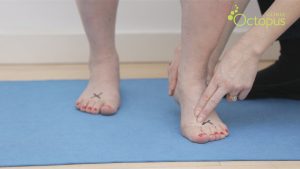
29 – Lower Limb Alignment: Pronation Of The Foot
The right foot movements while walking and especially running can be hard to master. But they are very important for...
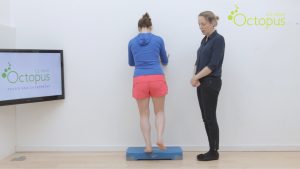
35 – Step: Eccentric Calves Heel Drops
This exercise is great if you are experiencing knee pain and need to strengthen and lengthen your calf muscles. Once...
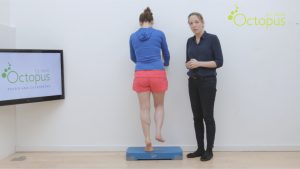
36 – Step: Eccentric Calves Heel Raises
This exercise is great if you are experiencing knee pain and need to strengthen and lengthen your calf muscles. This...
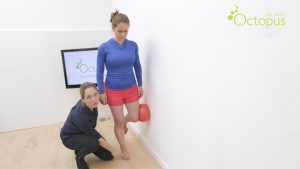
37 – Wall Ball: Stage 1: Standing
This video walks you through stage 1 in the Wall Ball Series. This is particularly good for lower leg alignment,...
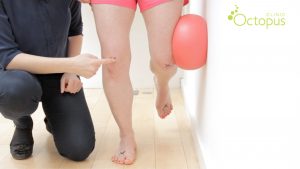
38 – Wall Ball: Stage 2: Knee Bends
This exercise is the second stage in the Wall Ball Series for leg alignment and strength. Make sure you’ve mastered...
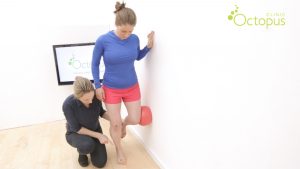
39 – Wall Ball: Stage 3: Heel Raised
This is the 3rd and final stage of the Wall Ball Series. In the first stage you mastered your alignment...
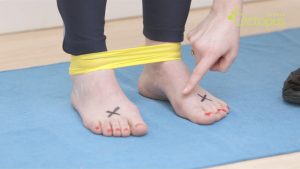
40 – Foot and Ankle: Strength with Band
Foot and ankle strength and alignment is really important for anyone with ‘flat feet’, or for any weight bearing activities....
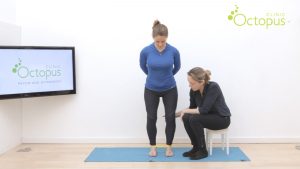
41 – Foot and Ankle: With Band and Knee Bend
Once you’ve learned the initial foot and ankle exercise here: 40 – Foot and Ankle: Strength with Band you can...
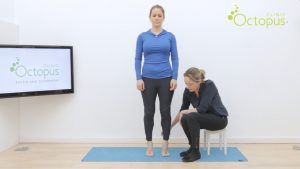
42 – Foot and Ankle: Alignment Up on Tip Toes
Before you try this exercise, make sure you’ve worked through the following two previous videos: 40 – Foot and Ankle:...
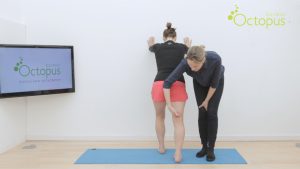
56 – Static Calf
Calf stretches are really useful after any exercise that involves jumping, running, stepping etc. You might find this stretch helpful...
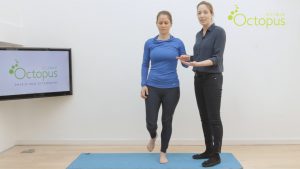
70 – Balance And Proprioception: Standing On One Leg
Good proprioception is an important part to injury recovery, to ensure you don’t cause more harm to injured areas. Poor...
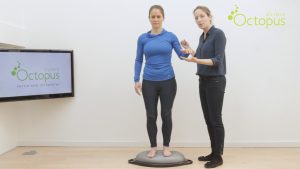
71 – Balance And Proprioception: Half Ball
Proprioception is very important for injury recovery and prevention. This is the second video in this series, so start here...
Please read the Headache page of this website before reading the following.
- Gentle neck stretching can help headaches so carry out Number 69.
- Correcting neck posture as shown in Number 66 can have an effect on headaches because of the nerves and blood vessels that come out of the neck and supply the head.
- Breathing exercises have huge benefits in getting the ribs and diaphragm moving. This increases circulation and movement right up to the base of the neck, positively affecting the nerves and blood vessels that come out of the neck and supply the head. Breathing exercises also help relaxation and the release of tension. Start with Number 78 and progress to Number 79 and Number 80.
- Number 7 is great for opening the chest and releasing the neck and upper back. This reverses the effects of being slumped over a lap top, phone, PC, steering wheel or desk.
- Training your lower abdominal muscles in a kneeling position strengthens the foundations on which your spine and head rest, as well as working your neck muscles against gravity. Start with Number 1 and build up to 2, 3 and 4.
- Shoulder posture can have a significant affect on the neck and therefore headaches, learn how to train the shoulder postural muscles in Number 12 and then progress to Number 13 when you feel ready.
- If you have no pain or other symptoms you can start to introduce neck strengthening exercises to prevent recurrence of your headaches. Start with Number 68 and progress to Number 81.
01 – Superman: Positioning
This is part 1 of the ‘Superman’ exercise series.The Superman exercise is great for core and back strength. Use this...
02 – Superman: Contract Deep Abs
This is the second video of the ‘Superman’ exercise series. The Superman exercise is great for core and back strength...
03 – Superman: Arms
This is the third video of the ‘Superman’ exercise series where we start adding some arm movement. The Superman exercise...
04 – Superman: Arms And Legs
This is the 4th and final video of the ‘Superman’ series. Here we add leg movements into the exercise. The...
07 – Foam Roller On Floor: Positioning Pelvic Neutral
Back pain is often caused by weakness in the muscles that stabilise your lower back and pelvis. Stability in these muscles...
12 – Shoulder: Posture/Position
Correct shoulder posture is key to reducing shoulder pain. Learn how to correct your own shoulder posture and movement in...
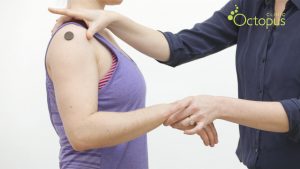
13 – Shoulder: Posture With Movement
This is the second video in our shoulder position series and shows you how to maintain shoulder posture with movement....
48 – Upper Back: Release On Foam Roller
This exercise shows you how to release your upper back on the foam roller. This can be very helpful for...
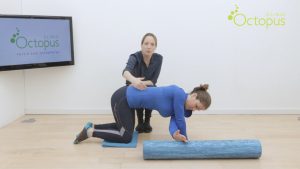
49 – Upper Back: Thread The Needle
Twisting exercises like this are great to mobilise your upper spine, release tension and can reduce and prevent back pain,...
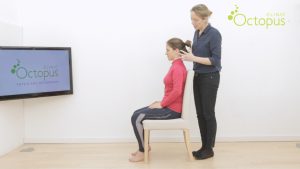
66 – Chair Exercises: Neck Posture
This is the first in our series on Chair exercises for the neck. You can follow this up with :...
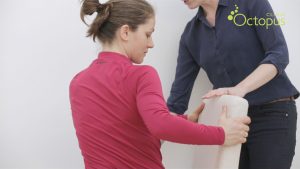
67 – Chair Exercises: Twist: Mobilisation Upper Back
The best exercise you can do at your desk are chair twists that mobilise your spine, release tension and can...
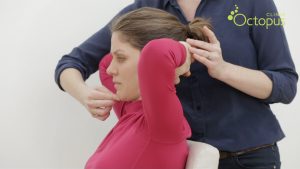
68 – Chair Exercises: Resisted Neck Strengthening
After you’ve got the correct neck posture using the first video in our Chair exercise series: 66 – Chair Exercises:...
Please read the chronic and complex pain page before considering the following exercises.
- Breathing techniques can really help your musculoskeletal system, circulation, heart, lungs and brain function when you are in pain. Practicing numbers 78, 79 and 80 will help you master this.
- Wherever you have pain in your body it is always good to make the movements as efficient as possible. By strengthening your lower back and pelvic stabilisers which provide the foundation for all movements you can improve on this efficiency. Start with lying on the foam roller with exercise Number 7 and then progress to Number 8 and 9.
- It is also important to work these muscles on your hands and knees so start with Number 1 and progress to Numbers 2, 3 and 4.
- Getting your standing posture right is key for most people, video Number 5 will enable you to do this.
- Likewise if sitting is something you do on a regular basis then Numbers 43 and 44 will be very helpful.
- The mid back is often the first to become stiff and you can release it yourself with numbers 48 and 49. Number 67 is particularly useful because you can do it sitting at your desk.
- Number 59 is great if you feel that your lower back needs loosening up, especially first thing in the morning.
- Correct lifting and carrying technique is essential to prevent low back pain in particular so check out Number 19 if this is you.
- Add Number 20 to start to address your leg alignment. You can incorporate this alignment into any squats, knee bends and leg press exercises you do.
- If you have upper back, neck or shoulder pain shoulder posture is important. Number 12 and 13 are useful for you as are the neck stretches in Number 69.
- Likewise if you have any foot, ankle or knee pain Number 40 gives you a great exercise to strengthen your feet and ankles.
These are just a taster of the exercises - please click on the area(s) of the body in which you feel pain to learn more exercises that could help you.
01 – Superman: Positioning
This is part 1 of the ‘Superman’ exercise series.The Superman exercise is great for core and back strength. Use this...
02 – Superman: Contract Deep Abs
This is the second video of the ‘Superman’ exercise series. The Superman exercise is great for core and back strength...
03 – Superman: Arms
This is the third video of the ‘Superman’ exercise series where we start adding some arm movement. The Superman exercise...
04 – Superman: Arms And Legs
This is the 4th and final video of the ‘Superman’ series. Here we add leg movements into the exercise. The...
05 – Standing And Walking Posture: Positioning And Stepping
We often have poor posture in standing which can lead to muscle imbalances and pain. This video will help you...
06 – Standing Hip Bend: ‘Waiters Bow’
This is an important exercise showing you how to bend properly from the hips while maintaining your pelvis and spine in...
07 – Foam Roller On Floor: Positioning Pelvic Neutral
Back pain is often caused by weakness in the muscles that stabilise your lower back and pelvis. Stability in these muscles...
08 – Foam Roller On Floor: Contract Pelvic Floor and Deep Abs
This is the second video in our foam roller series for back and hips. The stability of your low back and...
09 – Foam Roller On Floor: Knee Drops
This is the 3rd video in our Foam Roller series. These exercises are a great way of training your deep...
12 – Shoulder: Posture/Position
Correct shoulder posture is key to reducing shoulder pain. Learn how to correct your own shoulder posture and movement in...
13 – Shoulder: Posture With Movement
This is the second video in our shoulder position series and shows you how to maintain shoulder posture with movement....
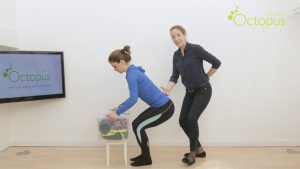
19 – Bending Lifting And Carrying: Technique
This video will show you how to lift and carry objects (and children!) safely to protect your back and other...
Please read the Static vs Dynamic stretching page to learn when these should and should not be done.
Static stretching should only be done after exercise, not during or before, and when the muscles are warm.
Quads - 54
Hamstrings - 55
Calf - 56
Adductors - 57
Buttocks and Glutes - 58
Hip Flexors - 60
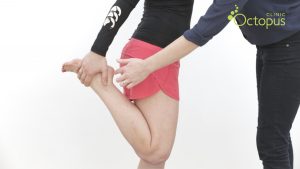
54 – Static Quadriceps
Stretching is a great way to finish your workout. Use our series of static stretching videos to target all the...
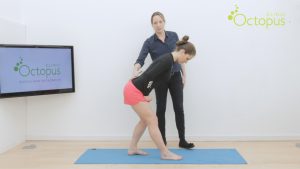
55 – Static Hamstrings
Stretching is a great way to finish your workout. Use our series of static stretching videos to target all the...
56 – Static Calf
Calf stretches are really useful after any exercise that involves jumping, running, stepping etc. You might find this stretch helpful...
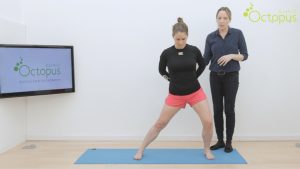
57 – Static Adductors
Stretching is a great way to finish your workout. Use our series of static stretching videos to target all the...
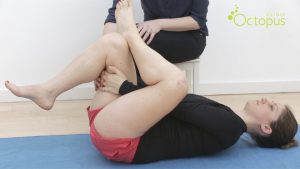
58 – Static Buttocks / Gluteal Muscles
Stretching is a great way to finish your workout. Use our series of static stretching videos to target all the...
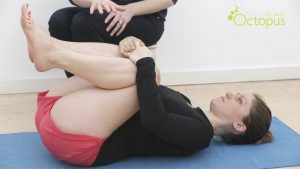
59 – Mobilise Lower Back Flexion And Rotation
Do you suffer from a stiff and tight back in the morning? Use this simple stretch before you even get...
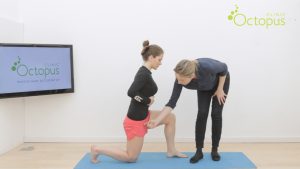
60 – Static Hip Flexors
Stretching is a great way to finish your workout. Use our series of static stretching videos to target all the...
67 – Chair Exercises: Twist: Mobilisation Upper Back
The best exercise you can do at your desk are chair twists that mobilise your spine, release tension and can...
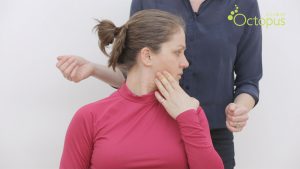
69 – Chair Exercises: Simple Neck Stretches
This is the last video in our chair exercise series and provides some great simple neck stretches you can do...
Please read the Static vs Dynamic stretching page to learn when dynamic stretching should and should not be done.
Dynamic stretching should be done before certain types of exercise when the body is warm.
Quads and Hamstrings - 61
Adductors and Abductors - 62
Hip Rotations and Openings - 63
Arms - 64
Upper Back and Body - 65
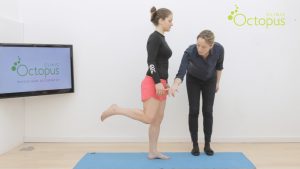
61 – Dynamic Quads And Hamstrings
Dynamic stretches are a great way to warm up for your workout, training or sports match. Check out the videos...
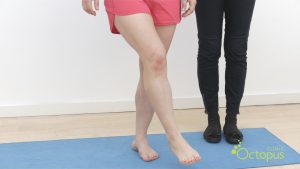
62 – Dynamic Adductors And Abductors
Dynamic stretches are a great way to warm up for your workout, training or sports match. Check out the videos...
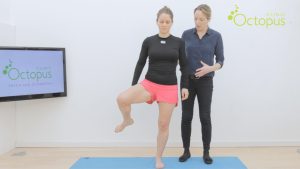
63 – Dynamic Hip Rotation And Opening
Dynamic stretches are a great way to warm up for your workout, training or sports match. Check out the videos...
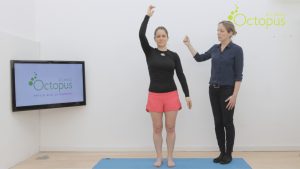
64 – Dynamic Arms
Dynamic stretches are a great way to warm up for your workout, training or sports match. Check out the videos...
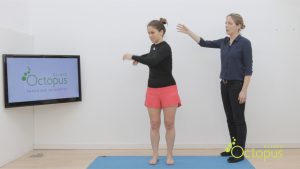
65 – Dynamic Upper Back And Body
Dynamic stretches are a great way to warm up for your workout, training or sports match. Check out the videos...
Please read the neck pages of this website before reading the following.
- Start with Number 69 - gentle neck stretching.
- Now learn the correct neck posture in Number 66.
- Breathing exercises move the ribs and diaphragm, increasing circulation and movement right up to the base of the neck. They also aid relaxation and release tension. Try number Number 78 and progress to Number 79 and Number 80 if they are comfortable.
- To open the chest and release the neck and upper back to reverse the effects of being slumped over a PC, phone, steering wheel or lap top, carry out Number 7.
- If your upper back is stiff the neck will have to move more causing more pain. To release the upper back use exercises Number 48, 49 and 67, the latter can easily be done at your desk at work.
- Training your lower abdominal muscles in a kneeling position strengthens the foundations on which your neck rests as well as working your neck muscles against gravity. Start with Number1 and build up to 2, 3 and 4.
- Shoulder posture can have a significant affect on the neck so train the shoulder postural muscles in Number 12 and then progress to Number 13.
- If you have no pain or other symptoms you can start to introduce neck strengthening exercises to prevent recurrence of your headaches. Start with Number 68 and progress to Number 81.
01 – Superman: Positioning
This is part 1 of the ‘Superman’ exercise series.The Superman exercise is great for core and back strength. Use this...
02 – Superman: Contract Deep Abs
This is the second video of the ‘Superman’ exercise series. The Superman exercise is great for core and back strength...
03 – Superman: Arms
This is the third video of the ‘Superman’ exercise series where we start adding some arm movement. The Superman exercise...
04 – Superman: Arms And Legs
This is the 4th and final video of the ‘Superman’ series. Here we add leg movements into the exercise. The...
07 – Foam Roller On Floor: Positioning Pelvic Neutral
Back pain is often caused by weakness in the muscles that stabilise your lower back and pelvis. Stability in these muscles...
12 – Shoulder: Posture/Position
Correct shoulder posture is key to reducing shoulder pain. Learn how to correct your own shoulder posture and movement in...
13 – Shoulder: Posture With Movement
This is the second video in our shoulder position series and shows you how to maintain shoulder posture with movement....
48 – Upper Back: Release On Foam Roller
This exercise shows you how to release your upper back on the foam roller. This can be very helpful for...
49 – Upper Back: Thread The Needle
Twisting exercises like this are great to mobilise your upper spine, release tension and can reduce and prevent back pain,...
66 – Chair Exercises: Neck Posture
This is the first in our series on Chair exercises for the neck. You can follow this up with :...
67 – Chair Exercises: Twist: Mobilisation Upper Back
The best exercise you can do at your desk are chair twists that mobilise your spine, release tension and can...
68 – Chair Exercises: Resisted Neck Strengthening
After you’ve got the correct neck posture using the first video in our Chair exercise series: 66 – Chair Exercises:...